Automotive Assistance Questions

I am on a moving trip right now, with all my stuff in my car, and stopped overnight along the way, at a friends house. After driving 7 hours one day, and 7 hours the next day with no problems, something odd happened right before I stopped overnight at my friend's place. The car's speed on the highway couldn't go over 60 mph.
It lasted the last few minutes of that leg of the trip. So I'm staying overnight with my friend wondering if it's just a fluke, or if it's going to be an issue the next time I get on the highway for the last leg of my trip.
What could cause the car to stop accelerating at 60 mph ? There were no other problems, and it drove fine at lower speeds. Could it be the weight of the contents in the car, since it's packed to the limit ? Like I said, I've already driven a total of 14 hours with all this weight, and it wasn't an issue before. Or could it be something else ?

How old is your truck? Newer trucks have a "safe mode" that won't allow you to go over 60mph for whatever reason. You'll have to flash the computer to get out of it, if that's the case. If you don't have a reader, Autozone or similar auto parts store should be able to tell you if you're in it.
 
Your catalytic converter is clogged. To my knowledge, it is the only possible cause. Get a vac test done on it to confirm. You can drive it for a while still, not too much longer though without fixing the problem. If you wait months to get it fixed, it will start to damage your valves. That is, if this is the culprit, and I'm pretty certain it is. But it won't just kill your engine while you're driving or anything.
 
Your catalytic converter is clogged. To my knowledge, it is the only possible cause. Get a vac test done on it to confirm. You can drive it for a while still, not too much longer though without fixing the problem. If you wait months to get it fixed, it will start to damage your valves. That is, if this is the culprit, and I'm pretty certain it is. But it won't just kill your engine while you're driving or anything.

He said it drove fine at lower speeds though - wouldn't you lose acceleration at all speeds with a clogged converter?
 
No, because the air pressure through your exhaust increases more as you accelerate. The more pressure, the more room it needs to get out. If it's clogged, that room is a lot less.
 
No, because the air pressure through your exhaust increases more as you accelerate. The more pressure, the more room it needs to get out. If it's clogged, that room is a lot less.

Right, but its a function of RPMs, not vehicle speed. He'd notice it more at higher speeds, but he should notice some stuttering at high RPMs if it was an exhaust issue. At least in my experience...I've only had exhaust issues with a VW Scirocco, so maybe its different for SUVs?
 
Right, but its a function of RPMs, not vehicle speed. He'd notice it more at higher speeds, but he should notice some stuttering at high RPMs if it was an exhaust issue. At least in my experience...I've only had exhaust issues with a VW Scirocco, so maybe its different for SUVs?
It's not a function of either. It's a function that results from combustion within the engine. When combustion occurs, the pressure created is expelled through the exhaust system so the engine doesn't explode. If the catalytic converter is clogged, it's like a narrow airway struggling to get enough air through. Think of it like blowing bubbles in chocolate milk. If you have a wide straw and blow slowly, you'll still get a lot of bubbles. But if you do the same thing with a coffee straw, you have to blow a lot harder to get the same result, and you feel the effects of that a lot more than with the wide straw.

The strain created at low RPMs isn't noticeable at all like it is at high RPMs, because you're forcing more air through a tighter space. It causes the engine to struggle, which results in not being able to expel enough air at higher RPMs to accommodate the higher acceleration, so it quits increasing at a certain point. It becomes like trying to drive through water.

And he's driving a car, not an SUV. And it wouldn't change things anyway.
 
My first thought is also the CAT. If the monolith is completely clogged, the vehicle will not start, but a partly collapsed or clogged monolith will let it run, just not at full power. Normally, a tell tale sign is a slight increase in engine temp, but if you don't have a gauge, you'll never spot it. Never mind causing a problem with valves, the most common result is a warped cyl head / blown head gasket if driven for extended periods.
 
It's not a function of either. It's a function that results from combustion within the engine.

Right...but at higher RPMs, combustion is happening faster. So when the engine is about to switch gears, for example, RPMs are high, combustion is happening quicker.

When combustion occurs, the pressure created is expelled through the exhaust system so the engine doesn't explode. If the catalytic converter is clogged, it's like a narrow airway struggling to get enough air through. Think of it like blowing bubbles in chocolate milk. If you have a wide straw and blow slowly, you'll still get a lot of bubbles. But if you do the same thing with a coffee straw, you have to blow a lot harder to get the same result, and you feel the effects of that a lot more than with the wide straw.

The exhaust system is to safely get rid of harmful gases & heat, not so much the pressure. Pressure is relieved through the combustion itself - this is how the engine creates power. For example, the catalytic converter's sole job is cleaning the exhaust, to limit air pollution. The blowing bubbles analogy is correct, but RPMs is a measure of how fast you're blowing the bubbles. Higher speeds = higher RPMs, but you'll also get higher RPMs at high accelerations.

The strain created at low RPMs isn't noticeable at all like it is at high RPMs, because you're forcing more air through a tighter space. It causes the engine to struggle, which results in not being able to expel enough air at higher RPMs to accommodate the higher acceleration, so it quits increasing at a certain point. It becomes like trying to drive through water.

And he's driving a car, not an SUV. And it wouldn't change things anyway.

Exactly my point - but you get higher RPMs at lower speeds at the top end of a gear, so right between 1st & 2nd gear, for example.


Anyway, we've gotten off topic - FTS, hope you get it figured out. If it is a catalytic converter, its a pretty cheap & easy fix. Good luck!
 
Impressive how everyone teamed together to assist on this one. Thanks, all of you.
So here's what happened.
I got back on the road, and instead of the speed capping completely at 60mph, it was able to gradually go above that, but very slowly, much slower than usual. So, I carefully made it to my final destination, and after unloading everything, I took it for a drive on the highway, and it seemed to be back to normal.
So, it seems as though the weight was an issue - or at least "part" of the issue - meaning that maybe a component like the Cat Converter or something else going bad, would cause it to respond more sensitively to a slightly heavy load ? Because it's hard to believe that the load was too much, in and of itself, because it's a V-8.
 
Impressive how everyone teamed together to assist on this one. Thanks, all of you.
So here's what happened.
I got back on the road, and instead of the speed capping completely at 60mph, it was able to gradually go above that, but very slowly, much slower than usual. So, I carefully made it to my final destination, and after unloading everything, I took it for a drive on the highway, and it seemed to be back to normal.
So, it seems as though the weight was an issue - or at least "part" of the issue - meaning that maybe a component like the Cat Converter or something else going bad, would cause it to respond more sensitively to a slightly heavy load ? Because it's hard to believe that the load was too much, in and of itself, because it's a V-8.

Glad you got it resolved, FTS!
 
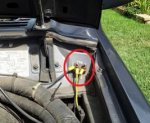
Anyone know what the hell the circled part in this pic is called? The black wire on the left is broken at the other end near the battery, and I can't see where it's supposed to connect. I'm almost certain it's a chassis ground wire, but I don't want to hook it back up based on assumptions and screw something up. This is on a 2001 Cherokee Sport.

piece.jpg
 
You have to replace both hubs on the front, you can't just replace one. Depending on your vehicle, am auto parts generally has 2 sets for $100. I don't have any idea how long you can drive on them, I drove on mine for about 300 miles and only replaced them out of paranoia lol.

Edit: I just checked, http://www.am-autoparts.com/ has 2 hubs for my truck for $85. I have a 98 Explorer 4WD, so if you have a car, it should be significantly cheaper.
 
Once you hear the sound of your Wheel Bearings start to go bad, approximately how long after that will they last, before they have to be replaced ?

I drove on mine for about 300 miles and only replaced them out of paranoia lol.

So, the answer to the question is, they need to be replaced, when the voices in your head tell you they need to be replaced.

:laugh:
 
Thanks. I got an SUV, so it'll probably be about that price, which isn't bad.....the question is how hard to do it yourself, and how expensive is the Labor aspect, if it's too hard for a novice to do himself.
It's extremely easy to do yourself, just very time consuming. To do two, you'll have to dedicate a good 6-8 hours to it. The most important things you need to have are jack stands, because you cannot do it without them, and make sure you get the massive socket you'll need to take the lug out of the center of the wheel, which can be any size between 29-38mm, and no tool set includes one that big. Just check online to see what size your wheel's center lug is. It takes a lot of muscle to get it moving, so you're gonna get a workout, so make sure to lube the hell out of it with WD-40 or PB Blaster. PB Blaster works better, but the fumes will knock you for a loop, they're pretty bad, that's why I use WD-40. Make sure you take it off with a torque wrench, because a regular wrench won't cut it no matter how strong you muscle it. Also, it's best to loosen that lug as much as possible before you get the wheel off the ground, because once it's in the air, all you will do is spin the wheel and not the lug.

Once that's done, take the tire off, disconnect the ABD cable (the only wire coming from the hub assembly) and take off the brake caliper. Make sure you have some zip ties or twine to tie the brake caliper off to something, because if you let it drop, you won't have brakes anymore. There are usually 3-4 bolts that hold on the caliper, 5 tiny ones that hold the brake dust shield, and one allen wrench bolt that holds the ABS cable on the unit. All of these other than the dust shield have the bolts on the back, so that's the biggest pain in the ass, but there are video and picture guides all over the internet that will walk you through it. Even if you have no idea what to do, these guides will simplify the hell out of it, so don't let the daunting timeframe and amount of work involved deter you, because it's not as bad as it sounds, it just takes forever. If you know someone with pneumadic tools to use, you'll cut your time down to less than an hour per side.

The beauty is, none of it comes off or goes on but one way, so you can't disassemble or reassemble it incorrectly, but definitely look up some videos and guides.

So, why would anyone in their right mind do this instead of taking it to a shop? Because a shop will charge you anywhere from $900-$1500 PER SIDE to do it for you. Free, regardless of the work involved, is always a better option.

 
As the bearings (balls) will seize, the outer housings will then try to rotate. If it is an axle bearing, the inner housing will rotate on the axle, and thus trashing that, whereas the outer housing will rotate within the axle housing, and creating damage there. As a bearing like that is an interference fit, any 'looseness' of the replacement bearing will continue to see it fail.

Look what happens when a main bearing 'spins' on a crankshaft! The crank has to be pulled so as to get the bearing surface machined back to a smooth condition, and if the big end of the conrod can't be repaired, you have to fork out the cost of a replacement.

Remember that wheel bearings are sealed, so they are already lubricated, but any damage to the seal will see the bearing's life reduce dramatically as this will allow foreign material to enter the bearing.
 

Users Who Are Viewing This Thread (Total: 1, Members: 0, Guests: 1)

Help Users

You haven't joined any rooms.

    You haven't joined any rooms.
    Top